
SEPA Members ICSET 2026 Presentations
Advances in the assessment, diagnosis and management of multidirectional instability of the shoulder (MDI) including patients with Ehler’s Danlos Syndrome (EDS). 60 min Symposium
Presenters: Professor Lori Michener, Dr Sarah Warby, Dr Lyn Watson, Prof. Dr. Ann Cools
Despcription: The aim of this symposium is to give attendants an understanding of the evidence surrounding the assessment and treatment of MDI, including those with EDS, and how to apply this knowledge in the clinical setting to optimise patient outcomes
Assessment, diagnosis and exercise-based management of posterior shoulder instability: Applications for the clinical setting: 60 min Workshop
Presenters: Jackie Sadi, BScPT, MSc, Ontario, Canada. A/Prof Tania Pizzari, Melbourne, Australia. PhD. B. Physio (Hon). Dr Lyn Watson Prof.Doc BAppSc(Physio)
Despcription: Despite the plethora of published rehabilitation programs for anterior instability, there are limited resources for clinicians for the conservative management of posterior shoulder instability (PSI).1,2 Given the typical aggravating factors inherent in PSI; rehabilitation programs need to be specific for the condition, yet clinicians are often unaware of which exercises and progressions produce optimal outcomes for PSI patients.
The objective of this workshop is for attendants to learn and practise the objective tests and exercise techniques to assess and treat PSI conservativity. Attendants will gain knowledge on how objective tests relate to the diagnosis and exercise selection in PSI as well the foundations of an evidence-based program that is specific for the condition.
Shoulder Strength Testing: From the Clinic to Elite Sport: 90 min Workshop
Presenters: Dr Rod Whitely PhD, Aspetar Doha, Simon Balster BPhty(Hons), Melb, Australia
Despcription: The primary aim of this workshop is to give attendants a thorough understanding of shoulder strength testing background, knowledge and practical skills to perform safe and reliable testing on their clinic patients or their sporting team. Then, to be able to analyse and use this information to make, data informed decisions on rehabilitation, strengthening progressions, readiness to return to work, gym or sport. Attendee will have the opportunity to break into small groups to practice the established handling techniques to reliably and repeatedly measure peak force using digital dynamometers.
These aims will be delivered within an evidence-based framework.
Assessment, diagnosis and exercise-based management of the unstable shoulder in multidirectional instability (MDI) and Ehler’s Danlos Syndrome (EDS) in the clinical setting.
90 min Workshop
Presenters: Professor Lori Michener, Dr Sarah Warby, Dr Lyn Watson, Prof. Dr. Ann Cools
Despcription: The aim of this symposium is to give attendants an understanding of the evidence surrounding the assessment and treatment of MDI, including those with EDS, and how to apply this knowledge in the clinical setting to optimise patient outcomes
Clinical reasoning to inform the choice of exercises for patients with shoulder dysfunction
90 min Workshop
Presenters: Karen Ginn, Ingrid Hultenheim Klintberg, Kathryn Fahy
Despcription: Exercise is the mainstay of conservative treatment for shoulder dysfunction. However, evidence to support the efficacy of specific exercises for different categories of shoulder dysfunction is limited leaving clinicians with the dilemma of how to choose effective, efficient exercises for their patients with shoulder dysfunction. This workshop will explore a rationale, evidence-based approach to determining and progressing patient-specific therapeutic shoulder exercises. It will begin by exploring recent evidence on the function of shoulder muscles, particularly the mechanisms whereby the rotator cuff and axioscapular muscles perform their stabiliser function, in order to provide you with the anatomical basis to explain the presenting shoulder symptoms. By applying this anatomical knowledge to the clinical assessment of the shoulder the workshop is designed to provide you with a logical, evidence-based clinical reasoning process to determine the most appropriate exercise strategy for each of your patients with shoulder dysfunction & to be able to progress these exercises in a functionally appropriate manner.
Rotation exercises to rehabilitate the rotator cuff – rotator cuff or axioscapular muscle exercises?
90 min Workshop
Presenters: Karen Ginn, Ingrid Hultenheim Klintberg, Kathryn Fahy
Description: Resisted rotation exercises are the mainstay of conservative treatment designed to rehabilitate the rotator cuff. But how specific are rotation exercises to the rotator cuff muscles & are they adequate to functionally retrain the rotator cuff for the crucial dynamic stability role this muscle group performs at the shoulder joint?
The workshop will begin by exploring recent evidence on the function of shoulder muscles, particularly the mechanisms whereby the rotator cuff and axioscapular muscles perform their stabiliser functions. This information will then be applied to analyse the rotator cuff & axioscapular muscle activity during rotation exercises commonly used in rotator cuff muscle rehabilitation programs
Back in the Game: A Multidimensional Return to Sport Approach after shoulder injury in contact and collision athletes
90 min Workshop
Presenters: Margie Olds, Edel Fanning
Description: Recurrent shoulder instability remains a significant challenge for athletes returning to sport, with high rates of reinjury underscoring the complexity of rehabilitation and readiness. Despite a growing body of research on physical performance tests (PPTs) for shoulder instability, their clinical adoption remains limited, and evidence supporting their predictive validity is sparse. Simultaneously, psychological readiness—a critical yet often overlooked component of rehabilitation—is rarely addressed in standardized protocols.
This workshop will emphasize a holistic, evidence-informed approach to return-to-sport (RTS) decision-making integrating cutting-edge physical testing, psychological strategies, and emerging technologies to optimize RTS outcomes for athletes recovering from shoulder instability.
When Shoulders Shake Confidence: Managing Fear After Dislocation
90 min Focused Symposium
Presenters: Margie Olds, Gisela Sole, Marianne van Gastel & Karin Hekman
Objectives:
To outline long-term psychosocial challenges experienced by people with traumatic anterior shoulder dislocations.
To outline development of guidelines (REGUIDE) to integrate physical and psychological components of rehabilitation following shoulder dislocations
To discuss assessment tools for kinesiophobia following traumatic shoulder dislocations, including development of a novel assessment using visual stimuli
To discuss the innovative role of virtual reality and imagery in rehabilitation of kinesiophobia and fear following traumatic anterior shoulder dislocations.
SEPA Funded Research
Grant assigned to: Dr Sarah Warby PhD
Investigation: The Effect of a Physiotherapy Directed Rehabilitation Program on Patients with Multidirectional Instability of the Glenohumeral Joint: A Multimodal Interventional MRI Study Protocol
Current Investigation Status: Currently recruiting control and subject participants. Complete data collected from 11 controls and 19 subjects with an aim for 30 participants in each. Link for MDI-fMRI study details
Publication(s): Study Protocol Article published in BMJ Open: https://bmjopen.bmj.com/content/14/2/e071287
SEPA Members Research
SEPA Members Published Research:
A Clinical Perspective

Does the WIP1 improve shoulder symptoms in Circus performers
Does our Watson Shoulder Instability Program improve the shoulder symptoms (strength, stability, function and anxiety) of circus performers with atraumatic shoulder instability symptoms?

Can we measure the area where frozen shoulders develop?
One of the signs of a frozen shoulder is inflammation related thickening of the inferior glenohumeral ligament. Can ultrasound measure the thickness ofthis ligament?

An examination of Rotator Cuff muscular balance in swimmers.
It is commonly believed that the shoulder external rotation (ER) to internal rotation (IR) strength ratio is decreased in swimmers due to predominant IR loading during the pull-through (propulsive) phase which predisposes to shoulder pain. However, the evidence supporting this hypothesis is inconclusive. Therefore, the aim of this study was to examine shoulder rotation strength parameters in elite swimmers and investigate potential associations with shoulder pain.
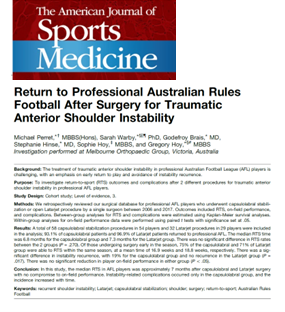
What can surgery achieve when you dislocate your shoulder in AFL.
The treatment of traumatic anterior shoulder instability in professional Australian Football League (AFL) players is challenging, with an emphasis on early return to play and avoidance of instability recurrence. This article investigates return-to-sport (RTS) outcomes and complications after Laterjet and Capsulolabral reconstruction procedures for traumatic anterior shoulder instability in professional AFL players.

How strong are your shoulder muscles? We can measure them.
Physiotherapists assess and measure the strength of patients muscles during every appointment. Here’s a method and technology that allows this measurement to be more precise and repeatable in shoulder muscles.